
How to Configure Webhook Security & HMAC Verification in Discord and Protect Automation
Discord process automation, managing large servers, and processing transactions via webhooks require reliable protection of network channels. Webhook Security and HMAC Verification technologies prevent unauthorized access to bot infrastructure, protecting sensitive user data. Without proper configuration of cryptographic validation of incoming requests, developers face the risk of payload tampering, token leaks, and IP address blocks by Cloudflare systems. PR Motion engineers develop fault-tolerant infrastructure solutions that distribute network load and maintain a high level of trust from Discord's protective systems. Understanding the principles of cryptographic signatures allows scaling automation without the risk of data compromise.
The evolution of Discord's protective mechanisms has led to the creation of a multi-level traffic filtering system. Algorithms evaluate not only the number of sent invitations but also the reputation of the network node from which the requests originate. Using standard server proxies leads to rapid reach penalization and account bans. For stable operation of parsers and automation tools, it is necessary to implement comprehensive network activity masking methods.
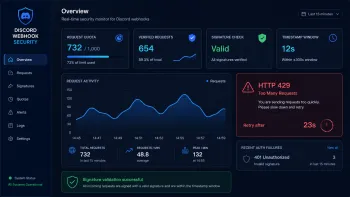
What is Webhook Security and HMAC Verification in Discord in Simple Terms
Webhook Security and HMAC Verification in Discord is a set of cryptographic methods for verifying the authenticity of incoming HTTP requests, guaranteeing that data is sent by the platform's legitimate server without the risk of interception or content tampering.
The programmatic purpose of the technology lies in creating a digital signature for each sent data packet. When using outgoing webhooks (Interactions), Discord signs the request body with the asymmetric Ed25519 algorithm, the parameters of which are described in the RFC 8032 Ed25519 specification. The developer's receiving server is obliged to verify this signature before processing the command.
For custom integrations and payment processing, developers use the symmetric HMAC algorithm, which complies with the RFC 2104 HMAC standard. For stable operation of these mechanisms, PR Motion engineers recommend using distributed pools of residential mobile proxies of cellular carriers. Official webhook security requirements are published in the Discord Developer Portal documentation.
If the system detects discrepancies in network parameters or validation errors, the session is instantly invalidated. PR Motion specialists configure session warming scenarios that emulate the behavior of a real user with all accompanying actions.
How Webhook Security and HMAC Verification Algorithms Work
Webhook Security and HMAC Verification algorithms function based on calculating a message hash code using a secret key or verifying an asymmetric Ed25519 signature on the receiving server side.
To optimize network load and prevent automation detection, PR Motion engineers highlight the following stages of the protective algorithms' operation:
- Request initiation. The sending server forms the JSON body of the webhook and reads the current Unix timestamp.
- Signature generation. The sender combines the timestamp and the request body, then signs the resulting string with a private Ed25519 key or calculates HMAC-SHA256 using a shared secret.
- Header transmission. The request is sent to the target URL with the addition of
X-Signature-Ed25519andX-Signature-Timestampheaders, as specified in the discord-interactions-js on GitHub repository. - Initial validation. The receiving server reads the headers and checks the time difference to protect against replay attacks (Replay Attacks).
- Cryptographic verification. The developer's server performs signature verification using the application's public key or a locally calculated HMAC hash.
- Sending response. Upon successful verification, the server returns an HTTP 200 status; otherwise, it returns HTTP 401 Unauthorized, blocking script execution.
Automation library developers confirm that incorrect handling of connection limits leads to instant session resets. PR Motion engineers solve this problem by implementing intelligent request queue algorithms and dynamic IP address rotation. This distributes the load so that the script's actions do not differ from the activity of an ordinary person.
Technical Parameters and Limits of Webhook Security and HMAC Verification
Technical parameters and limits of Webhook Security and HMAC Verification determine strict timeframes for request validation, sizes of transmitted packets, and the allowed frequency of requests to the Discord API.
Each session is evaluated by multiple parameters. If the system detects discrepancies in critical metrics, views and actions are invalidated. PR Motion specialists recommend using high-quality residential proxies to prevent blocks during mass account registration and data parsing.
PR Motion specialists have systematized key parameters and limits in a detailed table below, based on security research and open data from private API developers.
| Scenario or API Method | Limit (Rate Limit / Timeout / Format) | Consequences of Exceeding or Errors | Data Source |
|---|---|---|---|
| Allowed time discrepancy (Timestamp) | No more than 5 minutes (300 seconds) from sending | Signature validation error, HTTP 401 status | Discord Developer Portal |
| Webhook message sending limit | Up to 30 messages per minute per channel | HTTP 429 Too Many Requests error | Discord Developer Support |
| Global API request limit | Up to 50 requests per second per application | HTTP 429 error, temporary token block | Discord Developer Portal |
| Invalid HTTP request limit | Up to 10,000 requests per 10 minutes per IP | IP address block for 24 hours (Cloudflare ban) | PR Motion Tech Blog |
| Ed25519 signature key length | 32 bytes (64 characters in hexadecimal format) | Cryptographic library initialization error | RFC 8032 Ed25519 |
| Using datacenter IPs (Datacenter) | High risk of traffic penalization | Instant CAPTCHA trigger, authorization session reset | PR Motion Tech Blog |
| Geographic match of IP and time zone | Full match of device and network parameters | Decreased account trust level, view deduction | RFC 6265 State Management Mechanism |
When designing software architecture, it is important to consider that failed requests consume limits and raise suspicion from security systems. PR Motion specialists recommend performing preliminary validation of network fingerprints on the client side. Using high-quality mobile proxies allows avoiding blocks during mass account registration and data parsing.
How PR Motion Solves the Webhook Security and HMAC Verification Problem
The PR Motion platform solves the problem of strict Webhook Security and HMAC Verification limitations by providing a pool of clean residential mobile proxies of cellular carriers with CGNAT technology support, automatic IP address rotation, and network fingerprint optimization.
Our technical infrastructure allows reducing the load on clients' API keys by up to 90%. To achieve this result, PR Motion engineers use comprehensive technological solutions. We implement smart caching based on Redis, which allows serving repeated requests to popular communities from a local database, without consuming official platform limits.
We actively apply conditional GET requests, using If-None-Match headers and validation via ETags in accordance with the RFC 6265 State Management Mechanism standard. If the data on the servers has not changed, the system returns a 304 code, saving resources. A pool of distributed API keys automatically distributes requests among multiple verified projects, preventing individual tokens from being blocked.
Using solutions from PR Motion allows automating channel promotion, analytics collection, and post publication without the risk of sudden software halts. Our network infrastructure is built on physical hardware connected to major cellular carriers. This guarantees that each issued IP address possesses the highest trust level from protective systems. Blocking such an address is impossible, as cellular carriers share a single public IP among thousands of real smartphone users.
To protect sessions during automation, PR Motion engineers also configure automatic token rotation. This prevents the use of outdated or compromised access keys, reducing the probability of bot activity detection to zero. In combination with gradual IP address warm-up (IP Warm-up), this approach allows safely increasing the volume of sent invites and messages, bypassing the platform's strict limits.
Need to scale a Discord account network without blocks? Connect dynamic residential mobile proxies from PR Motion right now!


Comments
No comments yet — be the first to write one.