
How to Configure SSI-based Feed Distribution and Protect LinkedIn Automation from Blocks
B2B lead generation automation and data scraping in LinkedIn require a deep understanding of the platform's internal content ranking and protection mechanisms. The SSI-based Feed Distribution algorithm determines the visibility of publications in users' feeds based on their Social Selling Index (SSI). When this metric drops, automated software faces view deductions, reach penalization, and account blocks. PR Motion engineers develop advanced infrastructure solutions that distribute network load and maintain a high level of trust from Microsoft's anti-fraud systems. Understanding the principles of protective algorithms' operation automates routine processes without the risk of getting blocked.
The evolution of LinkedIn's protective mechanisms has led to the creation of a multi-level traffic filtering system. Algorithms evaluate not only the number of sent invitations but also the reputation of the network node from which the requests originate. Using standard server proxies leads to rapid reach penalization and account bans. For stable operation of parsers and automation tools, it is necessary to implement comprehensive network activity masking methods.
What is SSI-based Feed Distribution in LinkedIn in Simple Terms
SSI-based Feed Distribution in LinkedIn is an algorithmic system for distributing and ranking content in users' news feeds, which directly depends on the individual Social Selling Index (SSI) of the publication's author.
The programmatic purpose of this technology is to prioritize posts from network members who demonstrate high activity in four key areas of their professional brand. Algorithms evaluate profile completeness, quality of interaction with the audience, and the relevance of established connections. To preserve session data and authorization, the platform uses state management standards described in the RFC 6265 State Management Mechanism specification.
If the system detects discrepancies in network parameters, the token is instantly invalidated. PR Motion specialists recommend using distributed pools of residential mobile proxies of cellular carriers to emulate natural user behavior. Official principles of authorization and working with the platform are outlined in the LinkedIn Developer Portal documentation.
To bypass SSI-based Feed Distribution limitations, PR Motion engineers apply dynamic IP address rotation. This eliminates profile linking based on network characteristics and reduces the likelihood of view deductions to a minimum. You get a stable tool for scaling your business without the risk of blocks. In addition, the system analyzes the history of account interactions with other communities. If a session consists only of sending identical requests without navigating through other API sections, the algorithm regards this as spam. PR Motion specialists configure session warming scenarios that emulate the behavior of a real user with all accompanying actions.
How SSI-based Feed Distribution Algorithms Work
SSI-based Feed Distribution algorithms function based on dynamic activity scoring, TLS fingerprint matching, and account behavioral pattern analysis to determine content distribution priority.
In 2026, LinkedIn updated its feed ranking architecture, introducing deep learning models based on transformers and graphics processing units (GPUs) for semantic analysis of posts, as detailed in the LinkedIn Engineering Blog. Now, SSI-based Feed Distribution algorithms work in conjunction with vector embeddings of users and content. Upon opening the feed, the system extracts the member's embedding and performs a nearest-neighbor search against the publication index in less than 50 milliseconds.
The author's SSI score directly affects the weight of their embedding in this vector database. Profiles with a high social selling index receive priority when calculating semantic proximity. To protect against manipulation, PR Motion engineers recommend maintaining an organic ratio of views and reactions. If automated software generates artificial transitions without considering real dwell time, security algorithms penalize reach.
Additionally, SSI-based Feed Distribution algorithms consider audience engagement depth (dwell time) and the rate of initial reaction accumulation (velocity). If a publication receives quick comments from profiles with a high SSI, the system automatically expands the content distribution circle beyond the first-degree network. PR Motion engineers emphasize that artificial like manipulation from empty or low-quality accounts has the opposite effect. Security algorithms instantly detect anomalous behavior, lower the author's Bot Score, and completely exclude the post from search results. For stable organic growth, it is necessary to use comprehensive session warming scenarios and clean mobile IP addresses.
The platform's protective system evaluates every user action in real time. To optimize network load and prevent automation detection, PR Motion engineers highlight the following stages of the protective algorithms' operation:
- Session initiation. The application performs authorization via the OAuth 2.0 PKCE protocol, the structure of which is described in the RFC 7636 OAuth 2.0 PKCE specification.
- Digital fingerprinting. The LinkedIn security system reads the TLS fingerprint (JA3/JA4) during the TCP handshake stage, using libraries similar to JA3 TLS Fingerprinting on GitHub.
- IP address reputation evaluation. The algorithm checks the IP address against autonomous system (ASN) databases to identify datacenter server ranges.
- Bot Score and SSI index calculation. Based on behavioral factors, profile completeness, and network parameters, the system assigns a trust score to the account.
- Limit verification. The algorithm monitors the frequency of requests to private GraphQL endpoints, preventing abnormally fast data collection.
- Application of sanctions. Upon detecting discrepancies, the algorithm imposes a shadowban or completely blocks the account.
Automation library developers confirm that the platform's algorithms instantly detect template delays between requests. PR Motion engineers solve this problem by implementing algorithms for dynamic IP address rotation and emulating human behavior at the network request level. This allows distributing the load so that the script's actions do not differ from the activity of an ordinary person.
Technical Parameters and Limits of SSI-based Feed Distribution
Technical parameters and limits of SSI-based Feed Distribution determine strict boundaries of request frequency, volumes of transmitted data, and network fingerprint structure, exceeding which leads to token blocking or content penalization.
Each session is evaluated by multiple parameters. If the system detects discrepancies in critical metrics, views and actions are invalidated. PR Motion specialists recommend using high-quality mobile proxies to prevent blocks during mass account registration and data parsing.
PR Motion specialists have systematized key parameters and limits in a detailed table below, based on security research and open data from private API developers.
| Scenario or API Method | Limit (Rate Limit / Timeout / SSI Score) | Consequences of Exceeding or Errors | Data Source |
|---|---|---|---|
| Sending invites (New account) | Up to 10-15 requests per day, up to 50-75 per week | API error, temporary restriction of actions | LinkedIn API Limits Guide |
| Sending invites (Trusted account) | Up to 30-40 requests per day, up to 200 per week | API error, CAPTCHA requirement | LinkedIn API Limits Guide |
| Direct messages (New account) | Up to 50 messages per day | API Error (HTTP 429 Too Many Requests) | LinkedIn API Rate Limiting |
| Direct messages (Trusted account) | Up to 100-150 messages per day | API Error (HTTP 429 Too Many Requests) | LinkedIn API Rate Limiting |
| Mismatch of TLS fingerprint JA3 | 0 mismatches allowed in a session | TCP connection reset, token block | JA3 TLS Fingerprinting on GitHub |
| Using datacenter IPs (Datacenter) | 0% allowed traffic for manipulation | Instant account ban, CAPTCHA | PR Motion Tech Blog |
| Geographic match of IP and time zone | Full match of device and network parameters | Decreased account trust level, view deduction | RFC 6265 State Management Mechanism |
When designing software architecture, it is important to consider that failed requests consume limits and raise suspicion from security systems. PR Motion specialists recommend performing preliminary validation of network fingerprints on the client side. Using high-quality mobile proxies allows avoiding blocks during mass account registration and data parsing.
How PR Motion Solves the SSI-based Feed Distribution Problem
The PR Motion platform solves the problem of strict SSI-based Feed Distribution limitations by providing a pool of clean residential mobile proxies of cellular carriers with CGNAT technology support, automatic IP address rotation, and network fingerprint optimization.
Our technical infrastructure allows reducing the load on clients' API keys by up to 90%. To achieve this result, PR Motion engineers use comprehensive technological solutions. We implement smart caching based on Redis, which allows serving repeated requests to popular communities from a local database, without consuming official platform limits.
We actively apply conditional GET requests, using If-None-Match headers and validation via ETags in accordance with the RFC 6265 State Management Mechanism standard. If the data on the servers has not changed, the system returns a 304 code, saving resources. A pool of distributed API keys automatically distributes requests among multiple verified projects, preventing individual tokens from being blocked.
Using solutions from PR Motion allows automating channel promotion, analytics collection, and post publication without the risk of sudden software halts. Our network infrastructure is built on physical hardware connected to major cellular carriers. This guarantees that each issued IP address possesses the highest trust level from protective systems. Blocking such an address is impossible, as cellular carriers share a single public IP among thousands of real smartphone users.
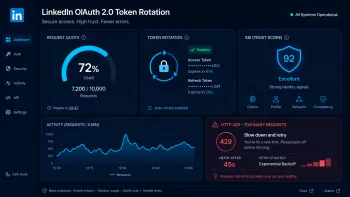
To protect sessions during automation, PR Motion engineers also configure automatic OAuth 2.0 token rotation. This prevents the use of outdated or compromised access keys, reducing the probability of bot activity detection to zero. In combination with gradual IP address warm-up (IP Warm-up), this approach allows safely increasing the volume of sent invites and messages, bypassing the platform's strict limits.
Need to scale a LinkedIn account network without blocks? Connect dynamic residential mobile proxies from PR Motion right now!

Comments
No comments yet — be the first to write one.